Workshop Choral Societies and Nationalist Mobilization in the 19th Century
National movements in nineteenth-century Europe were carried to an important extent by convivial sociability and cultural interests. A good example is furnished by the rise and function of male choirs from ca. 1810 onwards. Starting from initial foundational centres such as Berlin and Zurich, they obtained rapid popularity, proliferated by inspiring new foundations in an increasing number of cities, then established contacts and federative structures by means of trans-local, regional or nationwide festivals. Most German-speaking cities had their Gesangverein or Liedertafel by 1840, and the formula developed in many other European countries as well. In some of them (e.g., Wales and Estonia) choirs and choral festivals became an important vehicle for the assertion of a separate national identity, carried by large demotic sections of the population.
In spite of its wide-spread popularity and socio-political importance in the late eighteenth and early nineteenth century Europe, remarkably little attention has been given to this phenomenon by either cultural historians or musicologists.
The workshop is jointly hosted by NISE and SPIN and will take place in Antwerp. The programme has been finalized, no more papers will be accepted, but interested auditors are invited to register: info@spinnet.eu.
In the mid-to-late nineteenth century, male choirs were a feature of public life from Spain to Ireland and Wales and from Estonia to Transylvania. It affected large as well as small countries, established states as well as emergent nationalities. These choirs emphasized, in their choice of repertoire, patriotically-minded songs, which came to be composed in great number for them; conversely, they participated in public festivals and commemorations to add a nationally-inspired lustre to them (e.g. the Schiller commemoration in Stuttgart 1839, and the large choral festivals of Estonia). They galvanized or mobilized the active male part of the population with national fervour at a period before mass media and transregional communication reached full development.
Banknote database complete
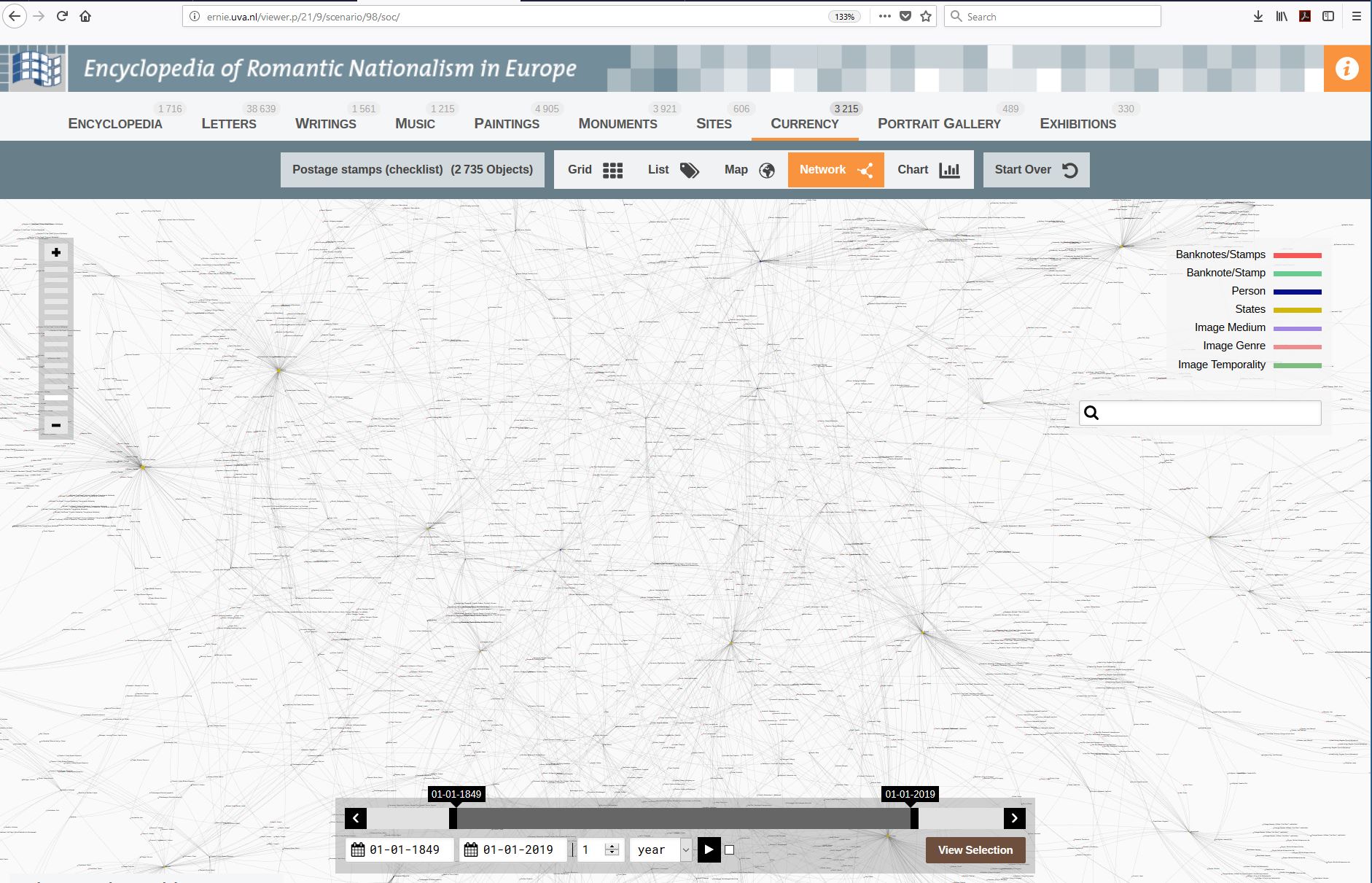
The interactive database of national icon-figures on European banknotes is now complete. It can be accessed through the interactive resources portal or by clicking "Resources" > Banknotes in the main navigation bar.
Romantic Rhine Travels
On 21 and 22 October a workshop will be held initiating a thematic research group on the Rhine as a cultural space in romantic nationalism. The participants will discuss the testimonies of generations of travellers from different countries and from different ideological persuasions form Byron to Schlegel and from Arndt to Victor Hugo. A new multinational body of evidence will hence be given on the new investment of the Rhine with both cultural and political meanings.
In the decades around 1800, the Rhine valley became an increasingly prominent feature in travels and travel accounts. As the mode of travel itself underwent a change from the educational Grand Tour to the romantic pilgrimage-quest for emotional authenticity, the Rhine valley became more than merely a passage between the Alps and the North-Sea, or between Berlin and Paris: travellers began to find in its picturesque landscape, medieval ruins and quaint twons a lieu de mémoire. A hidden valley perpetuating a true medieval-Gothic cultural continuum and harmoniuous between settlement and landscape.
A the same time, the Rhine's geopolitical importance in the Revolutaionary and Napoleon wars and the post-Napoleonic restauration invested it with the fateful ambivalance of being seen either as Germany's borderland or Germany's artery. Access to, and control over, was claimed by all its contiguous states.
This workshop is the initial meeting of what is proposed as a thematic research group on 'The Rhine as a cultural space in romantic nationalism, see: Rhine research group
Linguistic Revival Movements in Europe
On 3-4 June a workshop was held at the Study Platform on Interlocking Nationalisms in Amsterdam regarding language revivalism that emerged in Europe in the wake of Romantic Nationalism (1810-1880). Possibilities for establishing a research network were explored as well as means for applying for European funding. A comparative workshop will be organized in Maynooth (Ireland) next year.
Programme
Annual Report 2009
Report 2009
Encyclopedia of Romantic Nationalism in Europe
The Encyclopedia of Romantic Nationalism in Europe, or ERNiE for short, SPIN's core project, has now been definitively conceptualized. A PDF brochure detailing scope and structure has been placed online. It can be found on this website both both under "Documents" and under "Aims/Remit" > Core Project.
A Contents Management System has been set up, various publishers have shown interest and are now consultation partners, and authors and coordinating section editors are being approached.
Printed versions of the brochure are available upon request. Comments and suggestions are welcome.
Grimm's Germanisten Congresses (1846-47) to be placed online
SPIN will place a digitized version online of the proceedings of Jacob Grimm's congresses of Germanisten in Frankfurt (1846) and Lübeck (1847).
This initiative has been undertaken in association with the University Library of the University of Amsterdam, and with support from the Duitsland-Instituut Amsterdam and from Amsterdam University Press.
These congresses brought together the cream of Germany's philologists, historians and legal scholars, three specialisms united in what Grimm called Germanistik. The congresses consolidated the study of German culture and mentality into a new, authoritative discipline and also signalled the readiness of Germanisten to place this new discipline at the service of a new, increasingly assertive German nationalism. The delegates at these conferences not only represent some of the leading intellects of their generation (Arndt, Jacob and Wilhelm Grimm, Dahlmann, Droysen, Gervinus, Ranke, Uhland, etc.), many of them also were elected representative in the Frankfurt Parliament of 1848. In the discussions at these congresses, not only important philological agendas were outlined (such as the project of a comprehensive dictionary of the German lnguage, ultimately to become the benchmark Grimm Wörterbuch), but also matters of political import, such as the German claims on the contested territory of Schleswig-Holstein.
The proceedings of the Germanisten-congresses as a conduit from cultural to political nationalism are well-known, but the texts themselves have not been readily available. SPIN hopes to meet this desideratum. The texts will be placed online in two parallel forms: as PDFs of the original printed pages and in searchable transcript, with a search interface and accompanying background information.
Collegium Budapest and SPIN agree on research cooperation
Collegium Budapest (the Hungarian Institute for Advanced Studies) which is at present condicting a large project on "Medievalism, archaic origins and regimes of historicity: Alternatives to antique tradition in the nineteenth century in east-central, southeast and northern Europe" has agreed to explore possibilities for future cooperation with SPIN so as to bring further relevant topics and researchers from more European countries into this field of research. For more on the Collgium Budapest project, see under "Links".